

CattleVaccination & Prevention
Complete Cattle Vaccination Schedule 2026: Dairy, Beef & Calves
Cattle Vaccination Schedule Why Your Cattle Vaccination Schedule Is Your Most Valuable Investment Vaccination is the single most...

Neonatal calf diarrhoea — commonly called calf scours — is the leading cause of death in calves under one month of age worldwide. In the United States alone, USDA data shows that scours accounts for more than 56% of all pre-weaning calf deaths. In South Asia and Sub-Saharan Africa, the mortality rate in untreated outbreaks can exceed 70% when dehydration is severe.
The critical fact every cattle farmer must understand: calves almost never die from the diarrhoea itself. They die from dehydration, acidosis, and electrolyte loss. A calf that is losing fluid faster than it can absorb water will deteriorate within 24–48 hours. With correct, early rehydration treatment, the vast majority of scouring calves can be saved — even without antibiotics. This guide gives you the complete, evidence-based protocol.

Calf scours has multiple causes. Identifying the likely cause guides treatment, because not all scours is the same — and unnecessary antibiotic use contributes to resistance. Age of onset is the most useful field diagnostic tool:
| Age at Onset | Most Likely Cause | Key Features | Antibiotic Needed? |
| Day 1–2 | E. coli K99 (ETEC) | Profuse watery scours, very rapid dehydration | Yes — early and aggressive |
| Day 1–4 | Salmonella spp. | Blood in scours, high fever, very ill calf | Yes — systemic |
| Day 2–5 | Rotavirus | Yellowish scours, moderate dehydration | No — oral rehydration |
| Day 5–14 | Cryptosporidium parvum | Pale yellow scours, resilient to treatment | No — hygiene + rehydration |
| Day 7–21 | Coronavirus | Yellow/grey scours, may include respiratory signs | No (usually) — rehydration |
| Any age | Mixed infection | Variable signs, poor response to single treatment | Consult vet for culture |
Assess every scouring calf using this four-point scoring system. Your score determines whether you manage in the field or call your vet immediately.
| Score | Dehydration Level | Clinical Signs | Action |
| 1 — Mild | Less than 5% | Alert, standing, sucks well, skin springs back quickly | Oral electrolytes 2x daily — monitor closely |
| 2 — Moderate | 5–8% | Dull, weak but standing, sunken eyes, slow skin tent | Oral electrolytes every 4–6 hours — vet assessment |
| 3 — Severe | 8–10% | Unable to stand, cold extremities, no suck reflex | IV fluids urgently — call vet immediately |
| 4 — Critical | Above 10% | Comatose, hypothermic, very cold, barely responsive | Emergency vet — intensive care needed |
| ⚠ Emergency Signs — Call Your Vet NOW
Calf cannot stand or is unable to hold up its head Eyes sunken more than 1 cm into the socket Skin tent stays up for more than 4 seconds Calf will not suck and is unresponsive to stimulation Blood visible in scours combined with high fever Any calf that has not improved after 24 hours of oral rehydration |
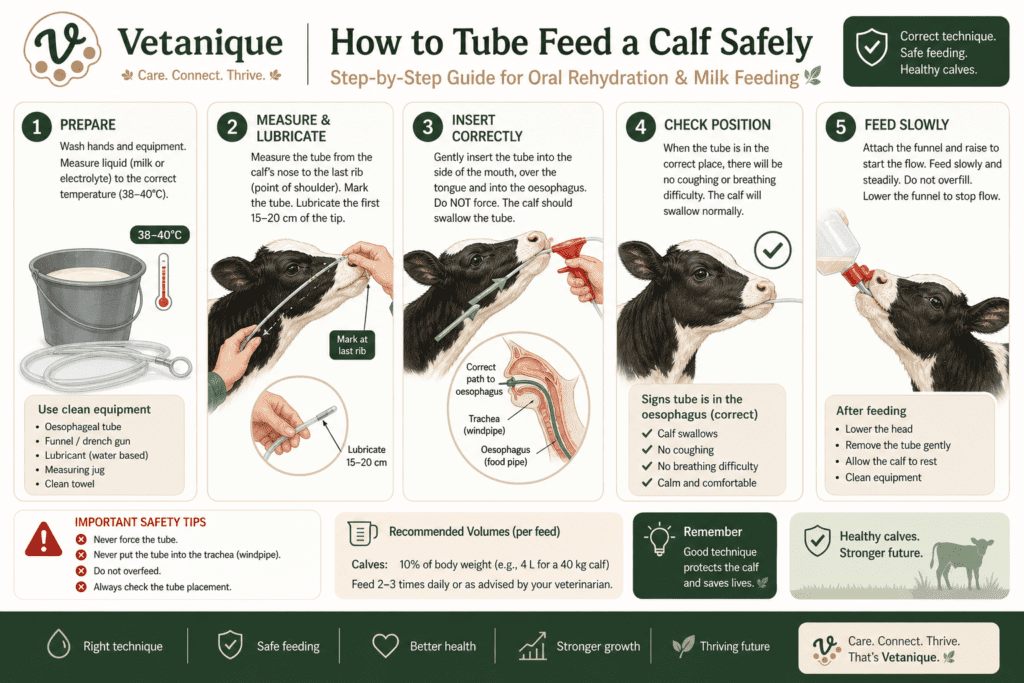
If commercial electrolytes are unavailable, the following emergency solution provides basic rehydration. Use commercial electrolytes as soon as possible — they contain amino acids and energy sources not present in this basic recipe.
Give 1–2 litres per feed, 3–4 times daily. This is a short-term emergency measure only — seek veterinary advice and access to commercial electrolytes as quickly as possible.
The single most powerful intervention for preventing calf scours is correct colostrum management. Research consistently shows that calves receiving adequate quality colostrum in the first hours of life have dramatically lower rates of scours, respiratory disease, and mortality throughout the pre-weaning period.
No — and this is one of the most common and damaging mistakes in calf management. Removing milk causes energy starvation and slows recovery. Multiple studies confirm that calves receiving both milk and electrolytes recover faster than those receiving electrolytes alone. Continue milk at normal volume. Simply add separate electrolyte feeds between milk feeds.
Most cases of calf scours are caused by viruses (rotavirus, coronavirus) or parasites (Cryptosporidium), which do not respond to antibiotics. Antibiotics are required when bacterial causes are confirmed or strongly suspected (E. coli K99 in Day 1–2 calves, or Salmonella at any age with fever and bloody scours). Unnecessary antibiotic use selects for resistant bacteria and does not improve recovery from viral or protozoal scours. Consult your vet for guidance.
With correct oral rehydration treatment, most viral and protozoal scours cases resolve within 3–5 days. E. coli scours treated with antibiotics within 12 hours of onset typically resolves in 2–3 days. Cryptosporidium cases are the most persistent — typically lasting 5–8 days even with good supportive care. If scours persists beyond 5 days without improvement despite treatment, consult your vet for further investigation.

Cattle Vaccination Schedule Why Your Cattle Vaccination Schedule Is Your Most Valuable Investment Vaccination is the single most...

Mastitis in Dairy Cows: Causes, Types, Treatment & Prevention The Real Cost of Mastitis — Why This Is...

Common Signs of Sickness in Cows Why Early Detection Is Worth More Than Any Drug A single missed...