
Calf Scours (Neonatal Diarrhoea): Causes, Treatment & Rehydration Protocol
Calf Scours: The Disease That Kills More Calves Than Any Other Neonatal calf diarrhoea — commonly called calf...
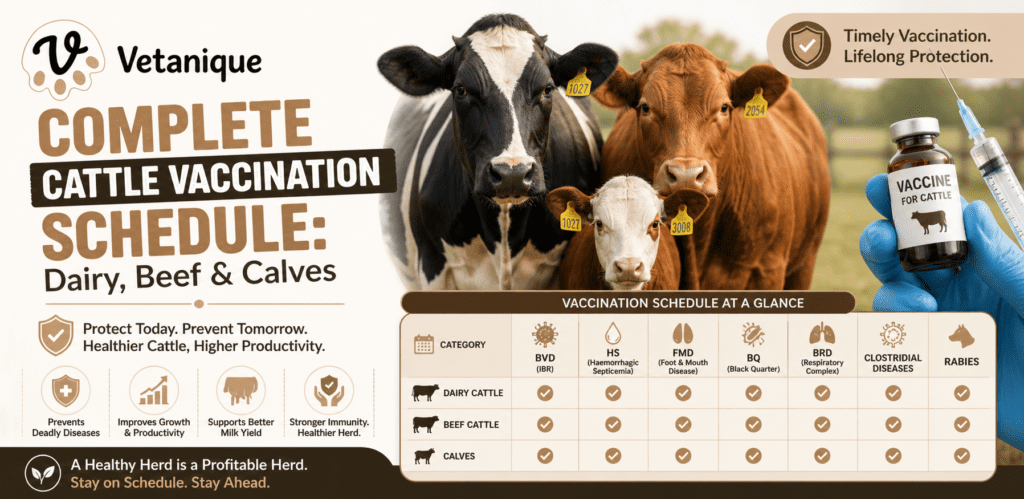
Cattle Vaccination Schedule
Vaccination is the single most cost-effective disease control tool available to cattle farmers worldwide. A single outbreak of Foot and Mouth Disease (FMD) can result in mass culling, multi-year trade bans, and farm losses exceeding hundreds of thousands of dollars. A clostridial disease outbreak (blackleg, pulpy kidney) can kill multiple animals in 24 hours — animals that could have been protected for a few dollars each per year.
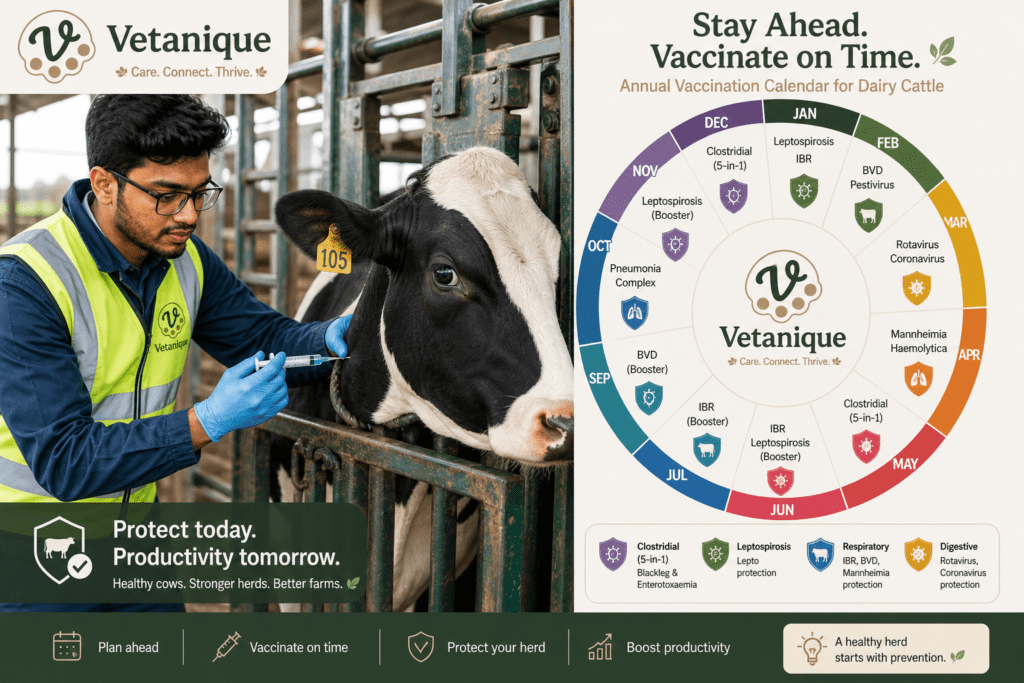
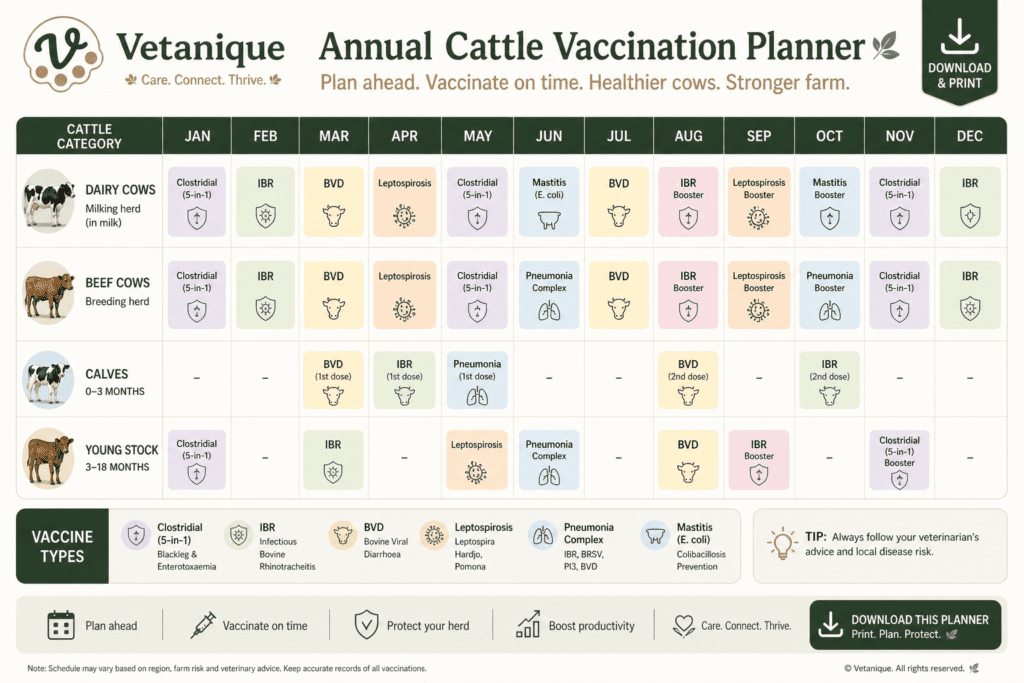
Despite this, underperforming vaccination programmes remain one of the most common problems identified in cattle herd health reviews. The most common failures are: starting too late, missing booster timing, incorrect storage (cold chain failure), and not covering all animals in the herd. This guide gives you a complete, practical vaccination schedule for 2025, tailored to dairy cattle, beef cattle, and calves.
Regardless of your location, production system, or herd size, these vaccine groups cover the most critical global cattle diseases. Regional additions are listed below.
| Vaccine Group | Diseases Covered | Who Needs It | Frequency |
| Clostridial (7-in-1 / 8-in-1) | Blackleg, pulpy kidney, tetanus, enterotoxaemia | All cattle | Annual booster (2x primary) |
| FMD Vaccine | Foot and Mouth Disease | Endemic regions | Bi-annual or as per national schedule |
| BVD Vaccine | Bovine Viral Diarrhoea | All breeding cattle | Annual (pre-breeding) |
| IBR Vaccine | Infectious Bovine Rhinotracheitis | Dairy & beef herds | Annual (intranasal or injectable) |
| Leptospirosis Vaccine | Leptospira hardjo (milk drop, abortion) | Dairy cattle | Annual (2x primary) |
| Lumpy Skin Disease | Lumpy Skin Disease virus | Endemic/emerging regions | Annual or emergency protocol |
| Timing | Vaccine | Route | Notes |
| 6–8 weeks pre-calving | Clostridial booster | Subcutaneous | Protects calf via colostrum |
| 6–8 weeks pre-calving | E. coli / Rotavirus (calves) | Subcutaneous | Colostrum protection for calves |
| 6 weeks pre-calving | Leptospirosis booster | Subcutaneous/IM | Annual — dairy essential |
| 6 weeks pre-calving | BVD booster | Per label instructions | Protect late gestation |
| 3–4 weeks pre-calving | IBR (if using MLV, must be done earlier) | Intranasal/injectable | Consult vet re timing |
| At drying off | Dry cow intramammary therapy | Intramammary | Mastitis prevention — essential |
| Post-calving (if endemic) | FMD booster | IM | Per national schedule |
| Annual (spring/autumn) | Clostridial booster for whole herd | Subcutaneous | All adult cattle |
| Timing | Vaccine | Route | Notes |
| Pre-turnout (spring) | Clostridial 7-in-1 booster | Subcutaneous | All adults — annual |
| Pre-breeding (6 weeks before) | BVD annual booster | Per label | Protect reproductive performance |
| Pre-breeding | IBR booster (if used) | Intranasal or injectable | Prevents IBR reproductive losses |
| Pre-housing (autumn) | Clostridial top-up for young stock | Subcutaneous | First-season cattle |
| Pre-housing | BRD vaccines (RSV, PI3, BVD, Mannheimia) | Intranasal/injectable | For housed beef — high risk |
| Endemic areas only | FMD — per national schedule | IM | Required for export access |
Newborn calves depend entirely on maternal antibodies (immunoglobulins) delivered through colostrum in the first 6 hours of life. This is your first and most critical immune intervention — not a vaccine, but essential for all vaccine programmes to work properly. Calves that miss quality colostrum in the first 6 hours have massively impaired immune response to all subsequent vaccinations.
| ⚠ Critical Vaccine Storage Rule
All cattle vaccines must be stored at 2°C–8°C. Never freeze. Never leave in direct sunlight. Cold chain failure is the #1 cause of vaccine ineffectiveness on farms. Always check the expiry date and reconstitute (where required) immediately before use. Use vaccines within the stated time after opening — discard unused portions. |
| Region | Additional Vaccines Recommended |
| South Asia (BD, IN, PK) | FMD (bi-annual mandatory), Haemorrhagic Septicaemia (HS), Anthrax |
| Sub-Saharan Africa | Anthrax, Lumpy Skin Disease, CBPP, ECF immunisation, Brucellosis |
| Southeast Asia | FMD, HS (Pasteurella), Brucellosis, Lumpy Skin Disease (emerging) |
| North America (US, CA) | BRD complex (4-way), Brucellosis (regulated), Leptospirosis 5-way |
| Europe (UK, EU) | IBR, BVD, Leptospirosis, Clostridial — TB testing required (not a vaccine) |
| Australia & NZ | Clostridial (5-in-1/7-in-1), Leptospirosis, Botulism (Queensland/NT) |
| Latin America (BR, AR) | FMD (mandatory), Brucellosis (regulated), Clostridial, Tick vaccines |
Most injectable vaccines provide protective immunity within 2–3 weeks of the final primary dose (or booster). For intranasal BRD vaccines, partial immunity develops within 3–5 days — making them useful for pre-housing use in beef cattle where housing date may coincide with disease risk. Plan your vaccination programme so that immunity is established before the peak disease risk period in your herd.
Missing a booster — particularly for clostridial diseases or leptospirosis — can result in waning immunity and return to susceptibility. For most vaccines, if a booster is overdue by more than 2–4 weeks, your vet may recommend restarting the two-dose primary course rather than continuing as a single booster. Do not simply give the booster late without veterinary advice — vaccination response may be suboptimal.
Many cattle vaccines are safe in pregnancy and are specifically designed for pre-calving use (particularly clostridial, leptospirosis, and E. coli/rotavirus vaccines). However, some modified live virus (MLV) vaccines for BVD and IBR must NEVER be given to pregnant cattle as they can cause abortion or foetal deformity. Always read the datasheet and consult your vet before vaccinating pregnant animals.
Calf Scours: The Disease That Kills More Calves Than Any Other Neonatal calf diarrhoea — commonly called calf...
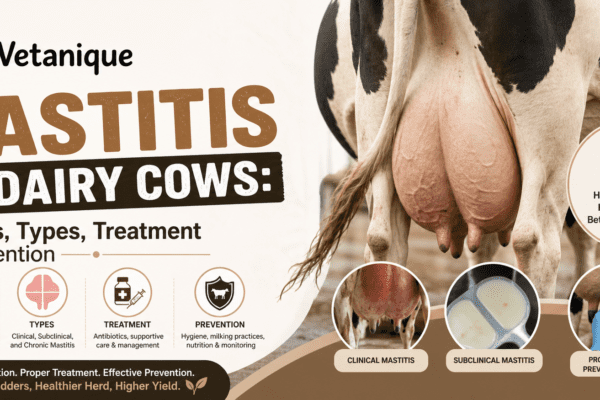
Mastitis in Dairy Cows: Causes, Types, Treatment & Prevention The Real Cost of Mastitis — Why This Is...
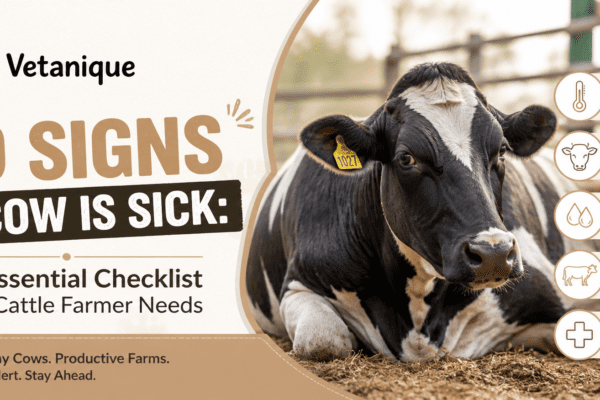
Common Signs of Sickness in Cows Why Early Detection Is Worth More Than Any Drug A single missed...