
PoultryVet Tips & FAQs
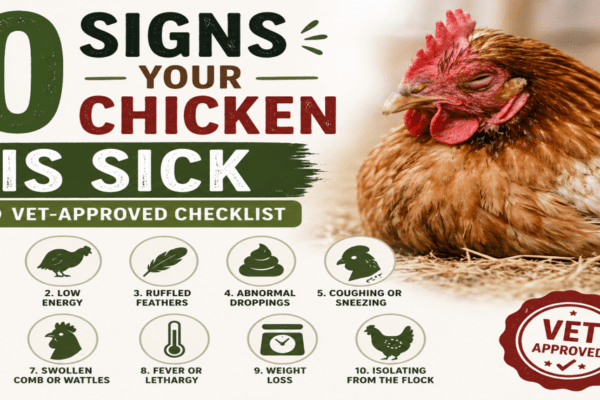
10 Signs Your Chicken Is Sick: Vet-Approved Checklist
Signs of Sick Chicken A sick chicken can decline within 24 to 48 hours — and by the...
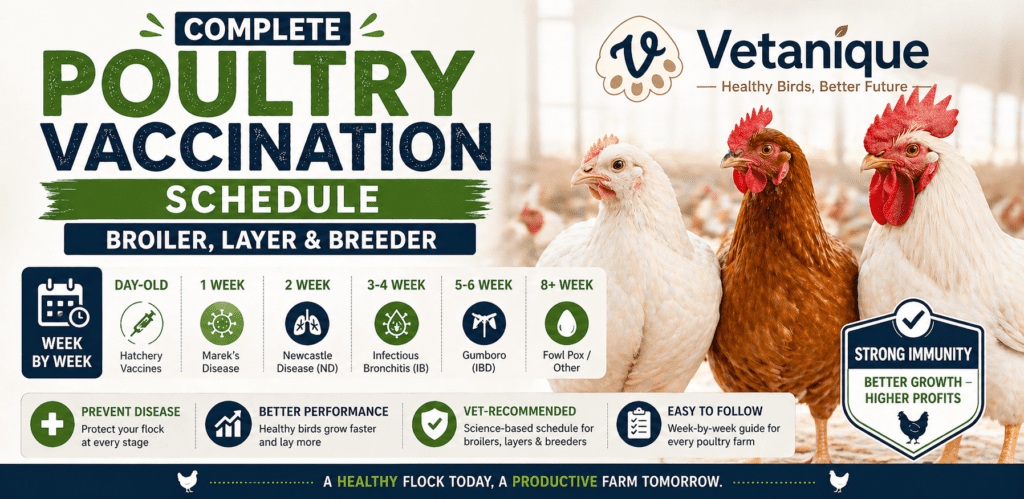
A correct poultry vaccination schedule is the single most cost-effective investment a poultry farmer can make. Vaccines costing cents per bird can prevent diseases that kill thousands of birds and devastate entire farms. But vaccination only works when the right vaccine is given at the right time, using the right route, with properly stored biologics. This complete week-by-week guide covers vaccination schedules for broilers, commercial layers, and breeders — and includes administration methods, cold chain requirements, and the most common mistakes that cause vaccine failure.
Whether you manage a backyard flock of 20 hens or a commercial house of 50,000 broilers, this guide is your definitive vaccination reference. Bookmark it, download the chart, and share it with your farm team.
Studies by the FAO estimate that up to 40% of poultry vaccinations in developing-country settings are ineffective — not because the vaccines are poor, but because of cold chain breaks, wrong dilution ratios, incorrect routes of administration, or timing errors. Understanding these failure points is as important as knowing the schedule itself.
KEY FACT: A vaccine given one week too early or too late can leave your flock completely unprotected. Maternal antibodies from the parent flock interfere with vaccines given too early. Delay leaves a dangerous window of vulnerability.
Broilers have a short production cycle (typically 35-42 days), so the vaccination window is tight. Every dose must count.
| Age | Vaccine | Disease Targeted | Route | Notes |
| Day 1 (Hatchery) | Marek’s HVT + SB1 | Marek’s Disease | SC injection | In-ovo or day-old. Non-negotiable. |
| Day 1 (Hatchery) | Newcastle (Clone 30 / B1) | Newcastle Disease (ND) | Spray / Eye drop | In hatchery spray cabinet |
| Day 7-10 | Gumboro (IBD) Intermediate | Infectious Bursal Disease | Drinking water | Monitor maternal antibody titres |
| Day 10-12 | Newcastle LaSota / Clone 30 | Newcastle Disease (ND) | Drinking water | Withold water 1 hr before |
| Day 14-16 | Gumboro IBD Boost (if needed) | Infectious Bursal Disease | Drinking water | Based on titre monitoring |
| Day 18-21 | Newcastle Booster (LaSota) | Newcastle Disease | Drinking water | Critical pre-stress period boost |
| Day 28 | Newcastle (if long cycle >42 days) | Newcastle Disease | Drinking water | Only for extended grow-out |
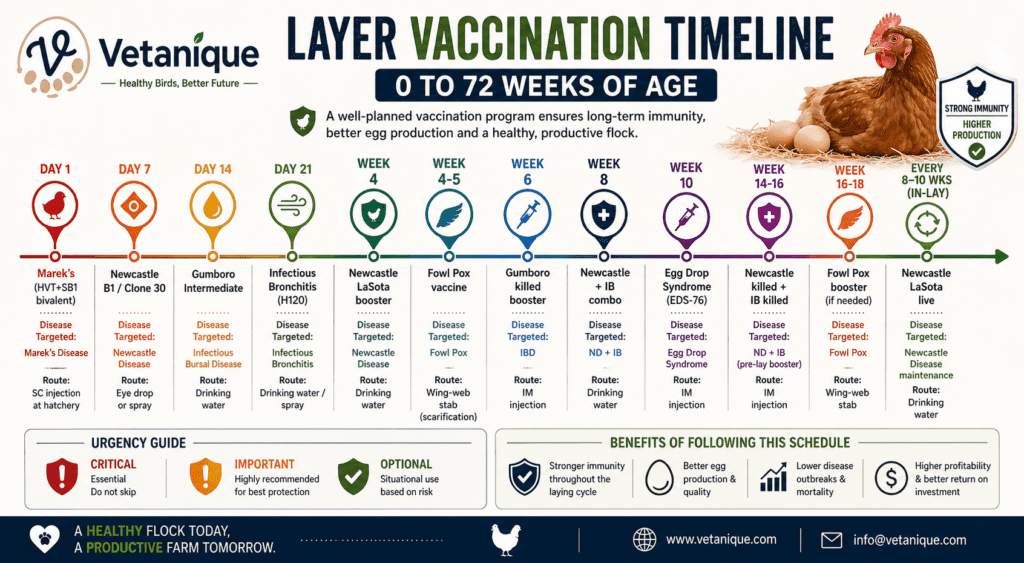
Layers have a longer production life (up to 72-80 weeks), which means more vaccines are required and boosters become critical to maintain immunity through the high-production phase.
| Age | Vaccine | Disease Targeted | Route |
| Day 1 | Marek’s (HVT+SB1 bivalent) | Marek’s Disease | SC injection at hatchery |
| Day 7 | Newcastle B1 / Clone 30 | Newcastle Disease | Eye drop or spray |
| Day 14 | Gumboro Intermediate | Infectious Bursal Disease | Drinking water |
| Day 21 | Infectious Bronchitis (H120) | Infectious Bronchitis | Drinking water / spray |
| Week 4 | Newcastle LaSota booster | Newcastle Disease | Drinking water |
| Week 4-5 | Fowl Pox vaccine | Fowl Pox | Wing-web stab (scarification) |
| Week 6 | Gumboro killed booster | IBD | IM injection |
| Week 8 | Newcastle + IB combo | ND + IB | Drinking water |
| Week 10 | Egg Drop Syndrome (EDS-76) | Egg Drop Syndrome | IM injection |
| Week 14-16 | Newcastle killed + IB killed | ND + IB pre-lay booster | IM injection |
| Week 16-18 | Fowl Pox booster (if needed) | Fowl Pox | Wing-web |
| Every 8-10 wks (in-lay) | Newcastle LaSota live | Newcastle Disease maintenance | Drinking water |
Breeders require the most comprehensive vaccination programme because their immune status directly determines the level of maternal antibody protection transferred to their chicks — protecting day-old chicks before they can be vaccinated themselves.
| Age | Vaccine | Route | Purpose |
| Day 1 | Marek’s bivalent | SC injection | Lifetime Marek’s protection |
| Weeks 1-18 | Full layer programme (above) | See above | Core immunity establishment |
| Week 18-20 (pre-lay) | Newcastle killed oil emulsion | IM injection | High maternal antibody transfer to chicks |
| Week 18-20 | IB killed + IB H120 live | IM + drinking water | Maternal IB antibody boost |
| Week 20 | Salmonella (Typhimurium/Enteritidis) | Oral / injection | Regulatory compliance + food safety |
| Week 20 | Reovirus (if local risk) | IM injection | Prevent viral tenosynovitis in offspring |
| Every 10-12 wks | Newcastle LaSota live booster | Drinking water | Maintain flock herd immunity |
Vaccines are biological products that are permanently destroyed by heat. Even a single temperature excursion above 8°C for a modified live vaccine can render an entire batch ineffective — and you will not know until birds start dying weeks later.
| Vaccine Type | Storage Temperature | Shelf Life | Critical Notes |
| Modified live (Lyophilised) | 2°C to 8°C (refrigerator) | As per label | NEVER freeze. Discard if seal broken. |
| Killed/oil emulsion | 2°C to 8°C | 12-24 months | Shake well before use. Warm to room temp. |
| In-ovo / Marek’s (HVT) | -196°C (liquid nitrogen) | Until opened | Use within 1 hour of thawing. No refreezing. |
| Reconstituted live vaccines | Use immediately (0-2 hrs) | N/A | Discard any unused reconstituted vaccine. |
COLD CHAIN RULE: If you are unsure whether a vaccine was properly stored during transit or storage, do not use it. The cost of a discarded vaccine is a fraction of the cost of a vaccine-preventable disease outbreak.
Not all vaccination programmes are equal across rearing systems. Here is how to adapt the core schedule:
| Rearing System | Key Adaptations |
| Commercial Broiler | Tight schedule, hatchery vaccination critical. Prioritise Marek’s, ND, Gumboro. |
| Commercial Layer | Full programme essential. Pre-lay killed boosters are non-negotiable for production. |
| Backyard / Small Flock | Minimum: Newcastle + Fowl Pox annually. Add Marek’s for chicks. Consult local vet for regional disease risk. |
| Free-Range / Organic | Higher biosecurity risk from wild birds — Newcastle and Avian Influenza monitoring critical. |
| Semi-Intensive (Asia/Africa) | Prioritise Newcastle and Gumboro (highest mortality causes in region). Vaccine quality and cold chain are the limiting factors. |
| Question | Answer |
| What vaccines do chickens need every year? | At minimum, all chickens need an annual Newcastle disease booster and Fowl Pox vaccine. Laying hens additionally need Infectious Bronchitis and Egg Drop Syndrome boosters. Commercial flocks follow a full programme; backyard flocks should consult a local poultry vet for region-specific recommendations. |
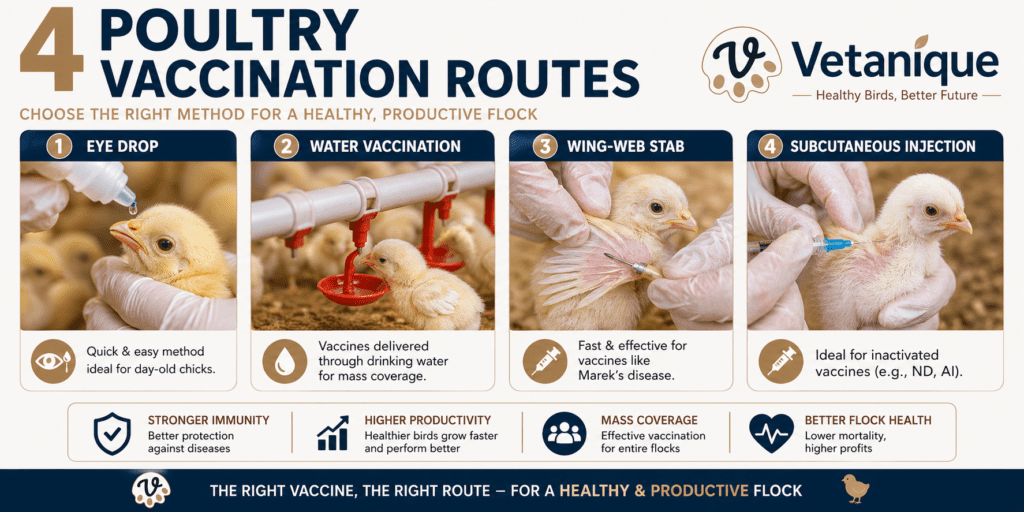
| Can you vaccinate chickens in drinking water? | Yes — water vaccination is the most common method for commercial flocks. Use chlorine-free water, add skim milk as a stabiliser, withhold water for 1-2 hours beforehand, and ensure birds consume all vaccinated water within 2 hours. Incorrect dilution is the leading cause of water vaccination failure. |
| At what age do you vaccinate chickens for Marek’s disease? | Marek’s vaccine must be administered on Day 1 of life — ideally in the hatchery within 24 hours of hatching. After Day 3, the window of effective vaccination closes significantly. It is a one-time lifetime vaccine; boosters are generally not required for non-breeder flocks. |
| Do backyard chickens need to be vaccinated? | Yes, particularly against Newcastle disease and Fowl Pox, which can devastate small flocks. Backyard chickens are often at higher risk of exposure from wild birds. Marek’s disease vaccination is strongly recommended for all chicks. Ask your local poultry vet for a region-appropriate schedule. |
| What is the withdrawal period after poultry vaccination? | Live vaccines generally have no withdrawal period for meat or eggs. However, some killed oil-emulsion vaccines may require a withdrawal period. Always read the product label. Antibiotic therapy given alongside vaccination may have its own withdrawal period — check with your veterinarian. |
| Why did my chickens get sick after vaccination? | Mild post-vaccination reactions (slight drop in feed intake, mild respiratory sounds for 1-2 days) are normal with live vaccines. Severe illness post-vaccination suggests: cold chain failure, wrong vaccine, incorrect dilution, secondary infection, or vaccination during an existing disease challenge. Consult your veterinarian. |
Signs of Sick Chicken A sick chicken can decline within 24 to 48 hours — and by the...